

how acupuncture works without touching the pain: understanding distal points

If you've ever received acupuncture for back pain and found needles placed in your hands, feet, or legs instead of directly on your back, you might have wondered: "How does that work?"
It's a great question, and the answer reveals one of the most fascinating aspects of acupuncture. In Traditional Chinese Medicine (TCM), we often treat pain and discomfort using what are called distal points: acupuncture points located far away from the area that hurts. This approach is especially helpful in community acupuncture settings, where you remain fully clothed and needles are placed only in areas that are easy to access, like your lower arms, lower legs, head, and ears.
Let's explore how this works, why it's so effective, and what the research says about treating pain from a distance.
What Are Distal Points?
Distal points are acupuncture points located away from the site of pain or illness. For example:
Needles in the hand or wrist to treat shoulder pain
Points on the lower leg to ease lower back pain
Needles in the foot to help with hip discomfort
Points on the forearm to address neck tension
In TCM, the body is understood as a network of pathways called meridians (or channels) through which energy, or Qi (pronounced "chee"), flows. These meridians connect different parts of the body. A point on your foot, for instance, might be part of the same channel that runs through your lower back. By stimulating that point on the foot, we can influence what's happening higher up along the channel.
Think of it like adjusting the flow of water through a garden hose. If there's a kink causing pressure in one section, you don't always have to touch that exact spot to release it. You can adjust the flow from another point along the hose.

Why Use Distal Points Instead of Local Points?
There are several reasons acupuncturists choose distal points:
1. Accessibility in Community Settings In community acupuncture clinics like Vital Qi, patients remain clothed and relax in reclining chairs in a shared space. This means we work with areas that are easy to reach: your lower arms, lower legs, ears, and head. Distal points allow us to effectively treat your whole body without asking you to undress or move to a private treatment room.
2. Often More Effective Many experienced acupuncturists find that distal points can be even more powerful than local points. Because these points are located along meridians that travel through the body, they can address not just the symptom but the underlying pattern causing the problem. A point on your leg might influence inflammation, circulation, and pain signals throughout your back and hips.
3. Safer and More Comfortable Some areas of the body are more sensitive or harder to needle directly. Distal points offer a gentler, often more comfortable way to bring relief. Many patients are surprised to find that a few tiny needles in their ankles can ease tension they've been carrying in their neck and shoulders for weeks.
What Does the Research Say?
Modern research supports what Chinese medicine practitioners have known for thousands of years: acupuncture works through multiple pathways in the body, and you don't need to needle directly at the site of pain to get results.
Studies using brain imaging have shown that stimulating acupuncture points, even far from the area of pain, activates regions of the brain involved in pain processing, inflammation control, and nervous system regulation. Research published in journals like Evidence-Based Complementary and Alternative Medicine has found that distal points can reduce pain and improve function just as effectively as local needling, particularly for conditions like low back pain, knee pain, and headaches.
One study found that acupuncture points on the hand and forearm significantly reduced lower back pain by influencing the central nervous system's pain response. Another showed that points on the leg improved mobility and comfort for people with chronic knee pain.
Acupuncture also stimulates the release of natural pain-relieving chemicals in the body, like endorphins, and can reduce inflammation and improve blood flow to injured or tense areas. All of this can happen whether the needles are placed locally or distally.
How It Feels During Treatment
Most people find distal point acupuncture to be deeply relaxing. You might feel a brief tingling, heaviness, or warmth at the needle site. This is called "De Qi" in Chinese medicine and is considered a good sign that the point is activated. Many people notice their pain easing during the session itself, or feel a sense of release and calm as tension begins to let go.
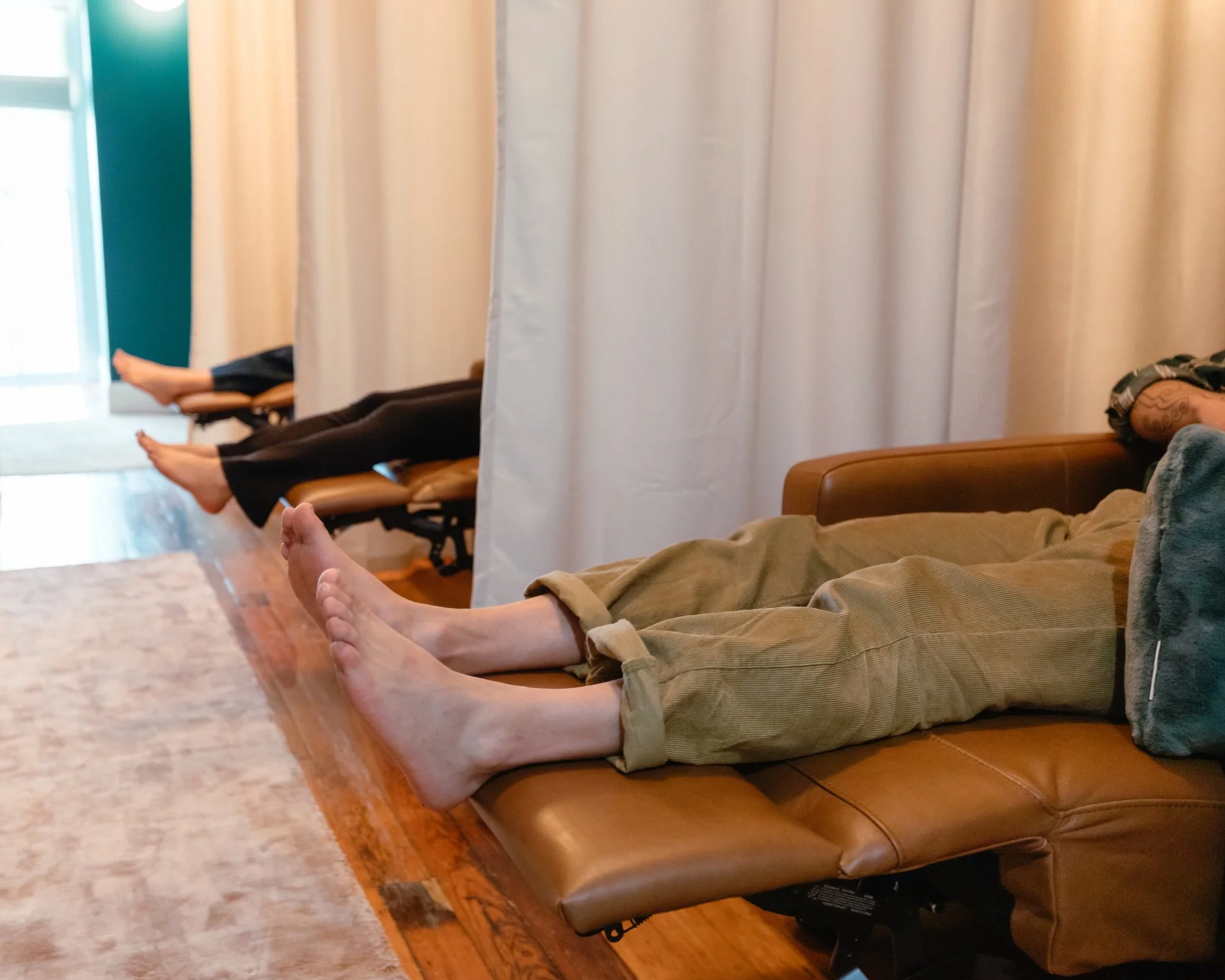
Because the needles are placed in accessible areas like your hands, arms, lower legs, and feet, you can stay comfortable and fully clothed throughout your treatment. You'll rest in a reclining chair, often with a blanket, in a peaceful shared space alongside others in the community.
Common Conditions Treated with Distal Points
Distal point acupuncture is effective for a wide range of concerns, including:
Low back pain and sciatica
Neck and shoulder tension
Headaches and migraines
Hip and knee pain
Digestive discomfort
Menstrual cramps
Anxiety and stress
Insomnia and fatigue
Community Care and Accessible Healing
At Vital Qi, we believe healing should be accessible, affordable, and grounded in community. Our community acupuncture model allows us to serve more people while keeping costs low. Using distal points means we can provide effective, full-body care in a setting that's comfortable, inclusive, and welcoming to everyone, whether you're new to acupuncture or a longtime supporter of holistic health.
Acupuncture reminds us that the body is interconnected. A point on your ankle can ease your back. A needle in your hand can calm your mind. Healing doesn't always happen where we expect it, and that's part of the beauty of this ancient medicine.
If you're curious about how acupuncture might support you, we'd love to welcome you into our space. You can learn more and book a session at vitalqi.com/book.
References
Zhao ZQ. Neural mechanism underlying acupuncture analgesia. Prog Neurobiol. 2008;85(4):355-375.
Zhang R, Lao L, Ren K, Berman BM. Mechanisms of acupuncture-electroacupuncture on persistent pain. Anesthesiology. 2014;120(2):482-503.
Choi EM, Jiang F, Longhurst JC. Point specificity in acupuncture. Chin Med. 2012;7:4.
Moffet HH. Sham acupuncture may be as efficacious as true acupuncture: a systematic review of clinical trials. J Altern Complement Med. 2009;15(3):213-216.
Napadow V, Ahn A, Longhurst J, et al. The status and future of acupuncture mechanism research. J Altern Complement Med. 2008;14(7):861-869.
Vickers AJ, Vertosick EA, Lewith G, et al. Acupuncture for chronic pain: update of an individual patient data meta-analysis. J Pain. 2018;19(5):455-474.
